Ken Ranosa
Book a 15-min call

Cadence.

Days do the work.

Weeks correct the course.

Months renew the system.

The target: sustained high performance.
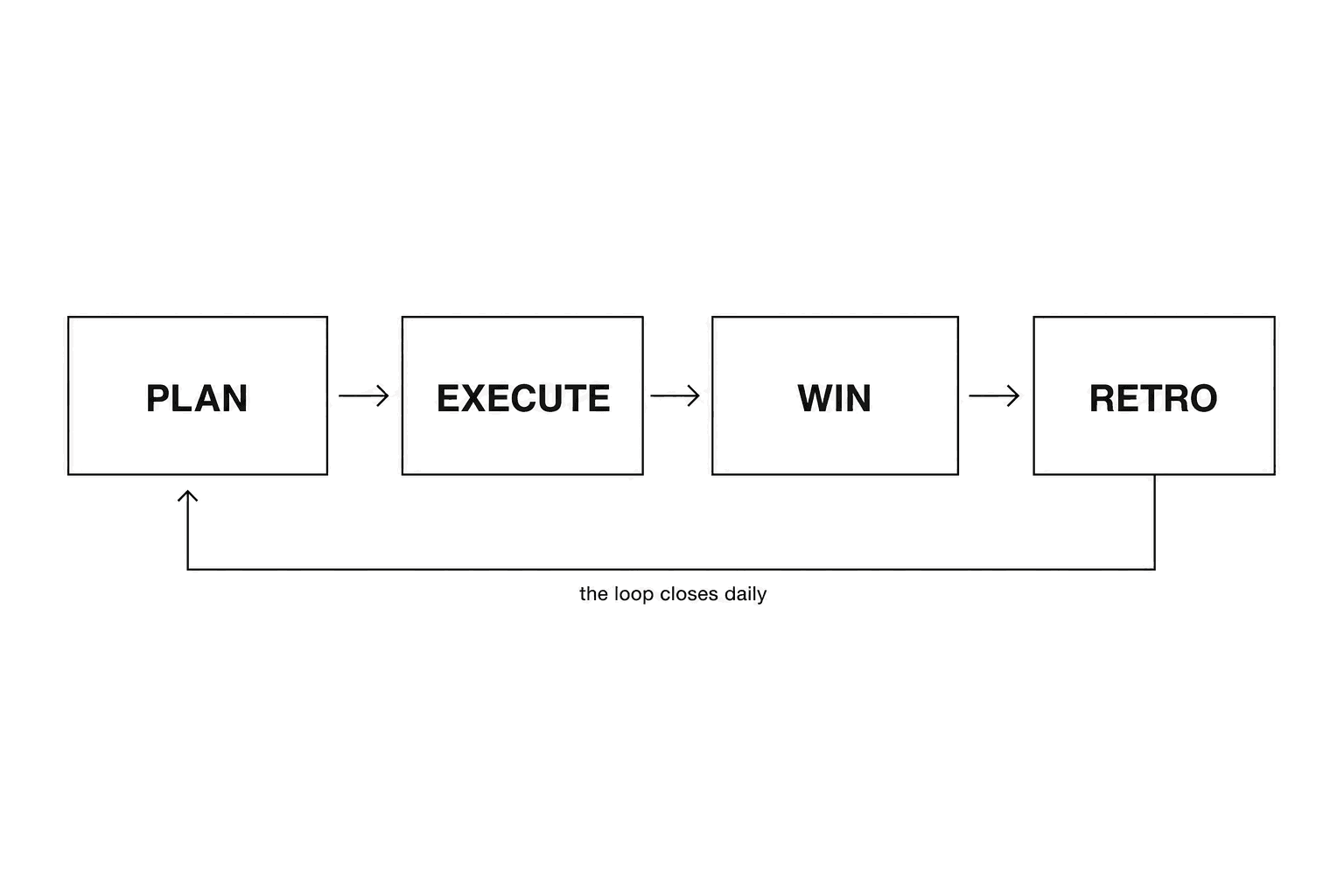
Process loop: PLAN to EXECUTE to WIN to RETRO, with a return arrow labelled “the loop closes daily”.

One loop, run daily.

Plan is written the evening before.

Retro closes the loop and writes the next plan.

Daily.

Six days a week, same shape.

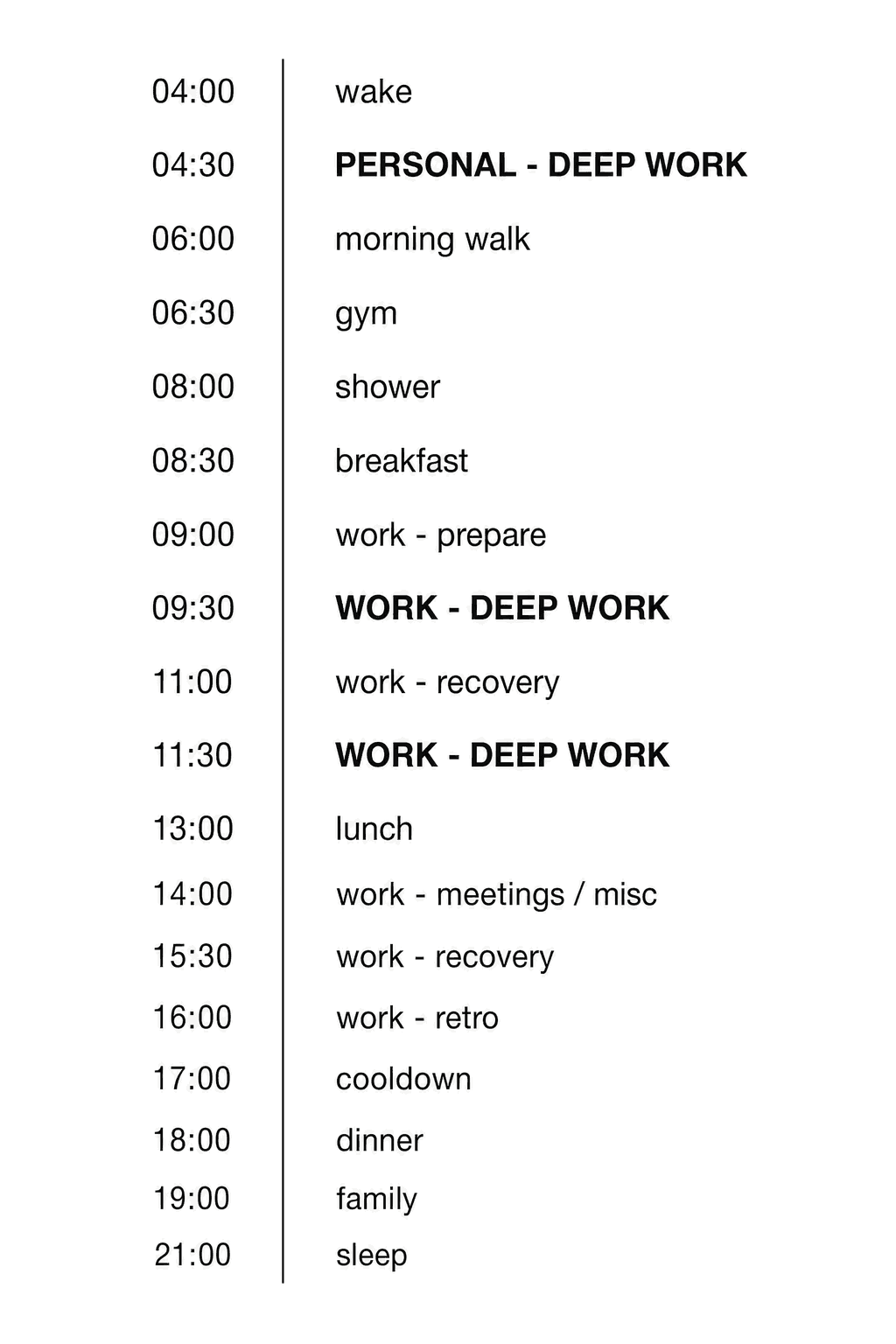
Vertical daily schedule: 04:00 wake, 04:30 personal deep work, 06:00 morning walk, 06:30 gym, 08:00 shower, 08:30 breakfast, 09:00 work prepare, 09:30 work deep work, 11:00 work recovery, 11:30 work deep work, 13:00 lunch, 14:00 work meetings and misc, 15:30 work recovery, 16:00 work retro, 17:00 cooldown, 18:00 dinner, 19:00 family, 21:00 sleep.
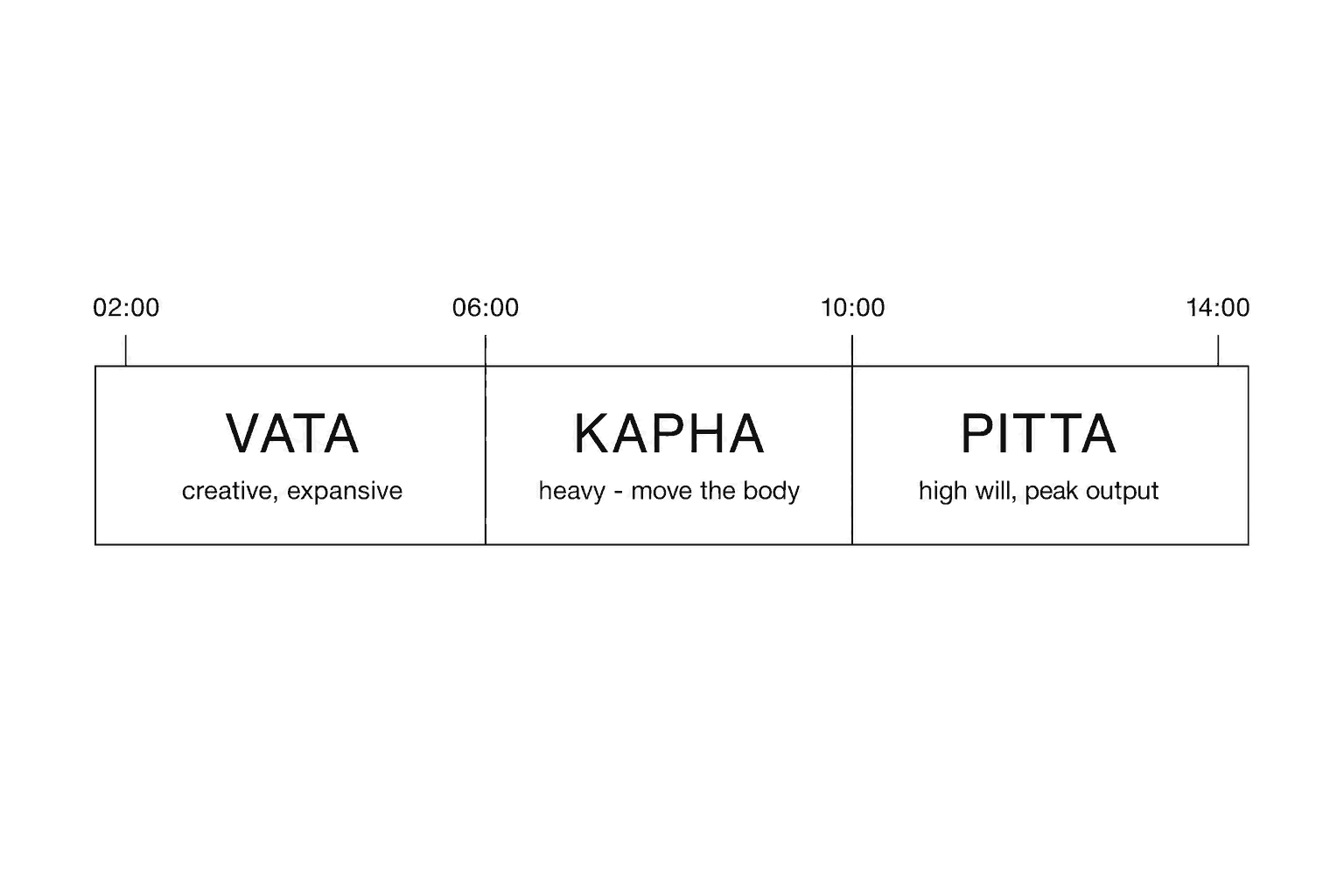
Timeline from 02:00 to 14:00 in three segments: VATA (creative, expansive), KAPHA (heavy, move the body), PITTA (high will, peak output).

The day follows the Ayurvedic clock.

The clock agrees with the research.

Creative work in vata hours.

The body in kapha hours.

Hard output in pitta hours. [9]

prepare
set the TODO: one main task, one supporting max
recovery
drink water · 12 min meditation · 10 min walking or stretching · clear the mind, let the subconscious work the task
retro
log DONE for the day · log TODO for tomorrow · what worked · what did not · what can improve

01

My goals get the first hours.

Personal deep work runs 04:30 to 06:00, before the world wakes.

The mission is funded before anyone else is paid. [9]

02

One main task. One supporting, max.

The day’s TODO is two lines long, on purpose.

When everything matters, nothing does.

03

Deep work is capped at 90 minutes.

Three blocks a day, 4.5 hours total.

That is the ceiling the research found in elite performers.

More is not deeper. It is shallower. [1]

04

Recovery is a block, not a break.

Water. Twelve minutes of meditation. Ten minutes of walking.

Clear the mind. The subconscious keeps working the task.

Between every two deep blocks. Output is paced, not squeezed. [4][12]

05

Tomorrow is decided at today’s retro.

At 16:00, daily: log DONE, set tomorrow’s TODO.

Morning is for execution, not deliberation. [5]

06

The day has hard edges.

Cooldown at 17:00. Family at 19:00. Sleep at 21:00.

The schedule protects the work, and everything the work is for. [6][7][8]

Weekly.

Six days on. One day off. On purpose.

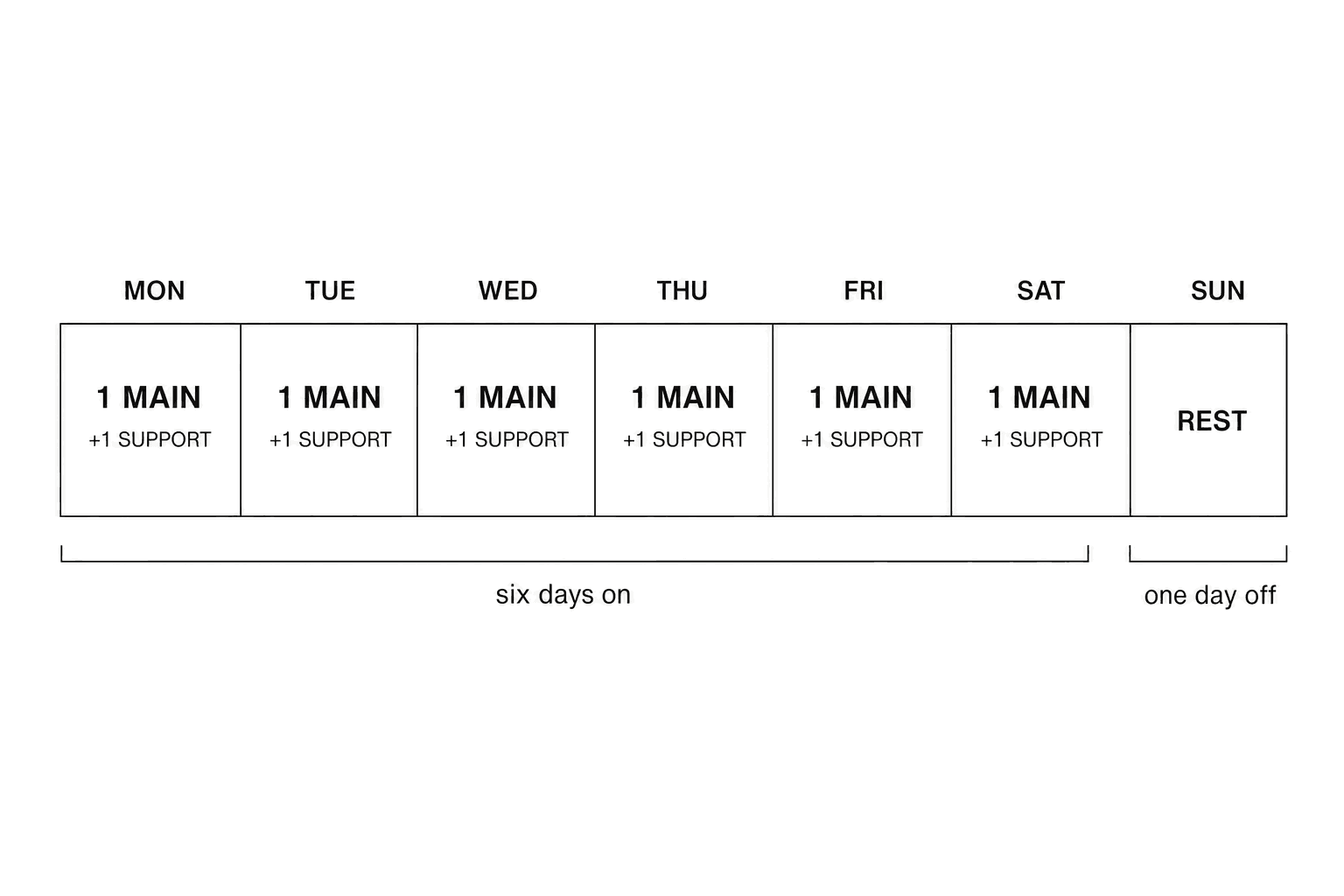
Seven-cell week bar: Monday to Saturday each marked “1 main +1 support” under the bracket “six days on”, Sunday marked REST under “one day off”.

Six days on, one day off.

Each day carries one main task and one supporting, max.

Stress plus rest equals growth: stress without rest is burnout, rest without stress is decay.

Sunday is not a gap in the system.

It is the system. [1][12]

scale

push

recover

block

90 min deep work

recovery block

day

one main task, one support

cooldown · family · sleep

week

six days on

sunday off

month

weeks 1-3 push

week 4 deload

The rhythm is fractal.

The same shape repeats at every scale.
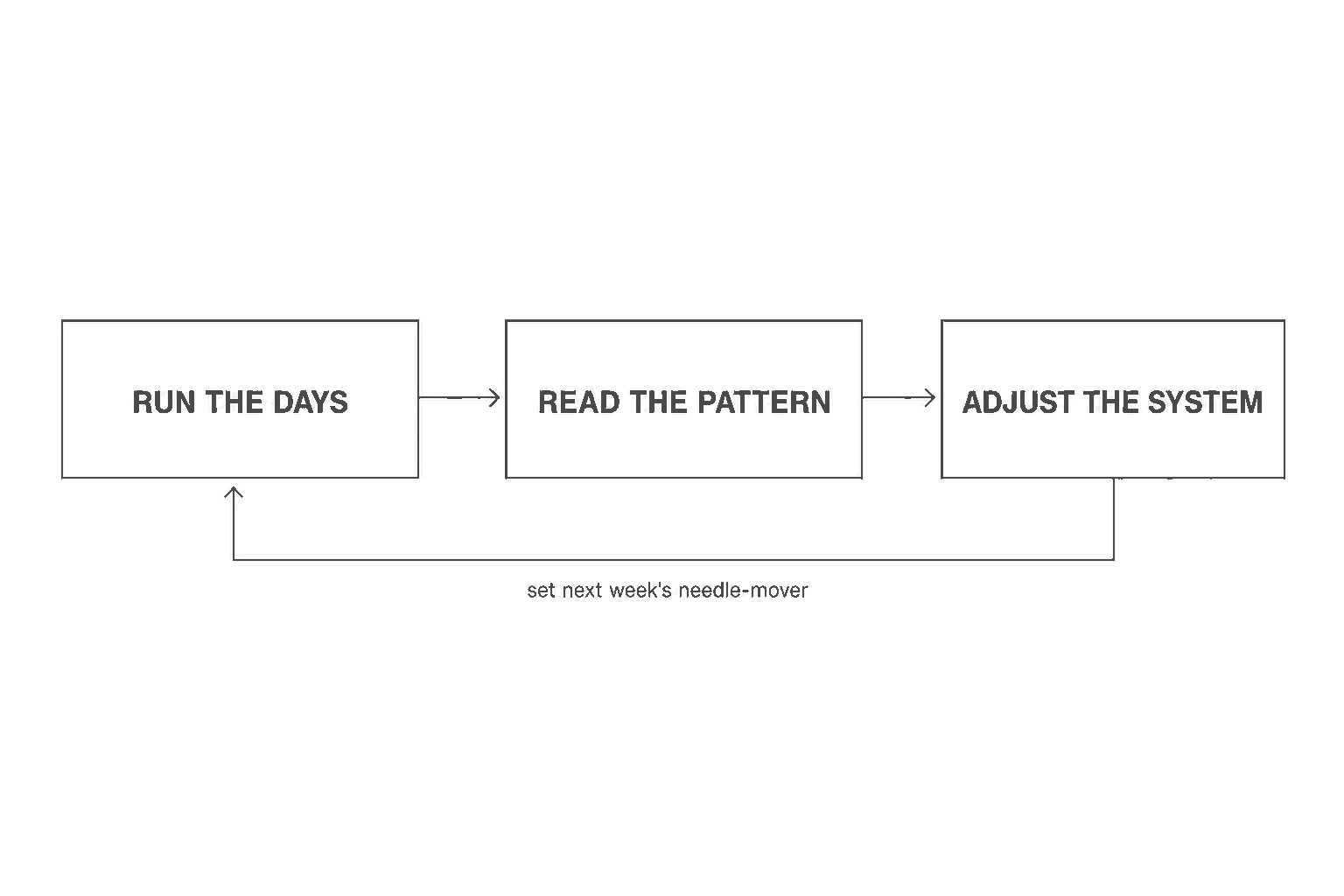
Process loop: RUN THE DAYS to READ THE PATTERN to ADJUST THE SYSTEM, with a return arrow labelled “set next week’s needle-mover”.

01

Read the pattern, not the day.

Six retros in a row tell the truth one day cannot.

02

Fix the system, not the effort.

A broken plan gets corrected, never abandoned.

03

Name the week’s needle-mover.

One outcome makes the week a win.

Everything else supports it or waits.

Monthly.

Three weeks up. One week down. On purpose.
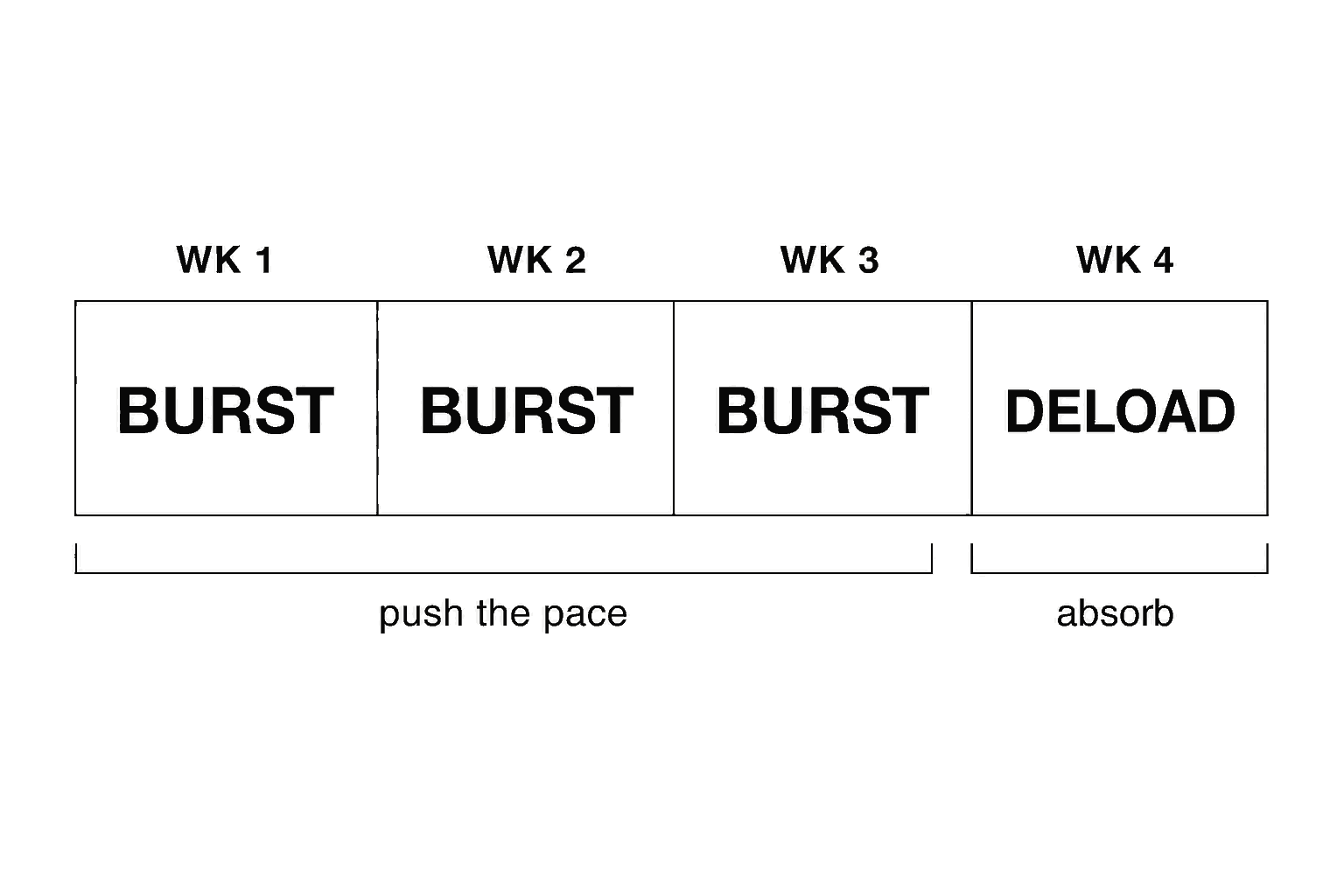
Four-cell month bar: weeks 1 to 3 marked BURST under the bracket “push the pace”, week 4 marked DELOAD under “absorb”.

Strategic burst, strategic rest.

Week 4 drops the load, not the structure.

Same schedule, lighter targets: maintenance, learning, sharpening tools, and the next month’s plan.

Athletes call it a deload.

Adaptation happens in the easy week, not the hard ones. [10]

Laws.

Decided in advance, so the day holds no debates.

01

Later is where discipline dies.

The task runs now or it is scheduled. There is no third place.

02

Unassigned tasks are wishes.

Time is claimed, not found. Every hour has an owner.

03

Freedom is structure that serves you.

The schedule is not a cage.

It is armor against other people’s emergencies.

04

Discipline is a decision made in advance.

Rules replace debates: no messages before deep work, train on

low days, if it is not scheduled it does not exist. [3]

05

Every hour is a vote.

How the hours are spent is how the next self gets elected.

An unplanned day votes for stagnation.

06

The day ends with proof.

Not busywork. Evidence.

Confidence is kept promises, especially the inconvenient ones.

07

Adjust, never abandon.

A broken plan is data. The question is never “did I fail?”

It is “what needs to change?”

Protocol.

For days when energy is zero.

Who are you when you are tired?

When you are unmotivated?

When no one is watching?

Loop until you forget your feelings, your expectations, your results.

01

Commands, not feelings.

Feelings are input, not orders.

Clarity is not found before acting. It is built by acting.

02

Start with the first atom.

Not “finish the project.” Open the file, type the first word.

Move within five seconds of the command. No debate window. [11]

03

Done is expected.

No celebration loop, no dopamine checkpoint.

That was expected. What is next?

04

Loop until it is automatic.

Command, execute, reset, until the loop runs itself.

Energized or tired, you do it anyway.

It is already who you are.

05

Ready is a myth.

Waiting to feel ready is the addiction.

The test of the system: it runs at zero.

06

No exits during a block.

The block has no backdoor: distractions deleted,

the deadline named out loud, stakes on the table.

Sources.

  1. [1]Ericsson et al., “The Role of Deliberate Practice” (1993): elite performers train in sessions under 90 minutes, about 4.5 hours a day. https://doi.org/10.1037/0033-295X.100.3.363Stulberg & Magness, Peak Performance (2017): stress + rest = growth. https://www.stevemagness.com/
  2. [2]Ratey, Spark (2008): exercise primes the brain for learning and focus. https://www.johnratey.com/
  3. [3]Gollwitzer, “Implementation Intentions” (1999): written if-then plans roughly double follow-through. https://doi.org/10.1037/0003-066X.54.7.493
  4. [4]Jha, Peak Mind (2021): 12 minutes of meditation a day protects attention under load. https://amishi.com/books/peak-mind/Albulescu et al. (2022): micro-breaks restore vigor and reduce fatigue. https://doi.org/10.1371/journal.pone.0272460Oppezzo & Schwartz (2014): walking boosts creative output around 60 percent. https://doi.org/10.1037/a0036577
  5. [5]Di Stefano et al., “Learning by Thinking” (2014): fifteen minutes of end-of-day reflection lifted performance about 20 percent. https://ssrn.com/abstract=2414478
  6. [6]Sonnentag & Fritz (2007): psychological detachment after work predicts recovery and next-day engagement. https://doi.org/10.1037/1076-8998.12.3.204
  7. [7]Harvard Study of Adult Development: relationship quality is the strongest predictor of long-term health and happiness. https://www.adultdevelopmentstudy.org
  8. [8]Windred et al. (2024): sleep regularity predicts outcomes better than sleep duration. https://doi.org/10.1093/sleep/zsad253
  9. [9]The 04:30 block sits in Brahma Muhurta, the pre-dawn window Vedic tradition reserves for the mind’s clearest work. https://en.wikipedia.org/wiki/BrahmamuhurthaThe dosha clock is Ayurvedic dinacharya: tradition, not lab science. Kept because it maps cleanly onto the findings above. https://en.wikipedia.org/wiki/Dinacharya
  10. [10]Bompa & Buzzichelli, Periodization: Theory and Methodology of Training (6th ed.): the 3:1 load/deload mesocycle: three weeks of progressive stress, one week of reduced load to absorb it. https://us.humankinetics.com/products/periodization-6th-edition
  11. [11]Robbins, The 5 Second Rule (2017): a five-second window between impulse and action, before the brain talks itself out. https://melrobbins.com/
  12. [12]WHO (2019): burnout is chronic workplace stress that has not been successfully managed. Rest is the management. https://www.who.int/news/item/28-05-2019-burn-out-an-occupational-phenomenon-international-classification-of-diseasesFritz & Sonnentag (2005): weekend recovery predicts lower exhaustion and better performance the following week. https://doi.org/10.1037/1076-8998.10.3.187Loehr & Schwartz, “The Making of a Corporate Athlete” (2001): high performance runs on oscillation. Stress followed by deliberate renewal, at every scale. https://hbr.org/2001/01/the-making-of-a-corporate-athlete

Control your day. Control your life.

How can I help?

Ken Ranosa

Senior Full-Stack Engineer

Test Infrastructure Edge

Remote from Makati, Philippines · GMT+8 · Available now

Need a senior engineer who can ship product and improve release confidence?

ken.ranosa@gmail.com

linkedin.com/in/mranosa

Remote from Makati, Philippines · GMT+8